Empathy Is a Leadership Skill—Not a Soft Skill
Empathy isn’t just a “nice-to-have” in leadership—it’s essential. In today’s workplaces, leaders aren’t just managing workloads; they’re managing emotions, motivation, and human connection. Empathy is what makes leadership relational, not just transactional. Psychology, as a scientific field, studies how empathy operates in human beings, highlighting its importance as a universal trait among human beings.
It’s the difference between a manager who enforces policies and a leader who earns trust.
There are two primary forms of empathy, and empathy can take many forms:
- Cognitive empathy – Understanding another person’s perspective. This involves perspective taking, which is critical for leaders who want to communicate effectively, reduce bias, and lead diverse teams.
- Emotional empathy – Feeling what another person feels. This helps leaders build connection and emotional trust—two things data shows are crucial for high-performing teams.
The good news? Empathy isn’t something you’re born with or without—it’s a skill leaders can develop through intention and practice. Empathy can be developed by actively engaging in perspective taking and practicing compassionate behaviors.
The Link Between Empathy and Mental Health at Work

Empathy and mental health go hand in hand. Great leaders understand that emotionally healthy teams are more productive, innovative, and loyal. Emotional health, alongside mental health, is equally important for team well-being.
Here’s the connection:
- Empathy requires emotional regulation, and that’s supported by good mental health.
- Leaders who prioritize psychological safety in the workplace enable team members to be more empathetic toward one another.
- Recognizing signs of burnout, anxiety, or stress in your team—and responding with empathy—is one of the most powerful acts of leadership.
But remember: you can’t pour from an empty cup. Your own mental health and emotional health need to be a priority if you’re going to lead with emotional intelligence.
Empathy and mental health in the workplace not only benefit individuals and teams but also contribute to a healthier society overall.
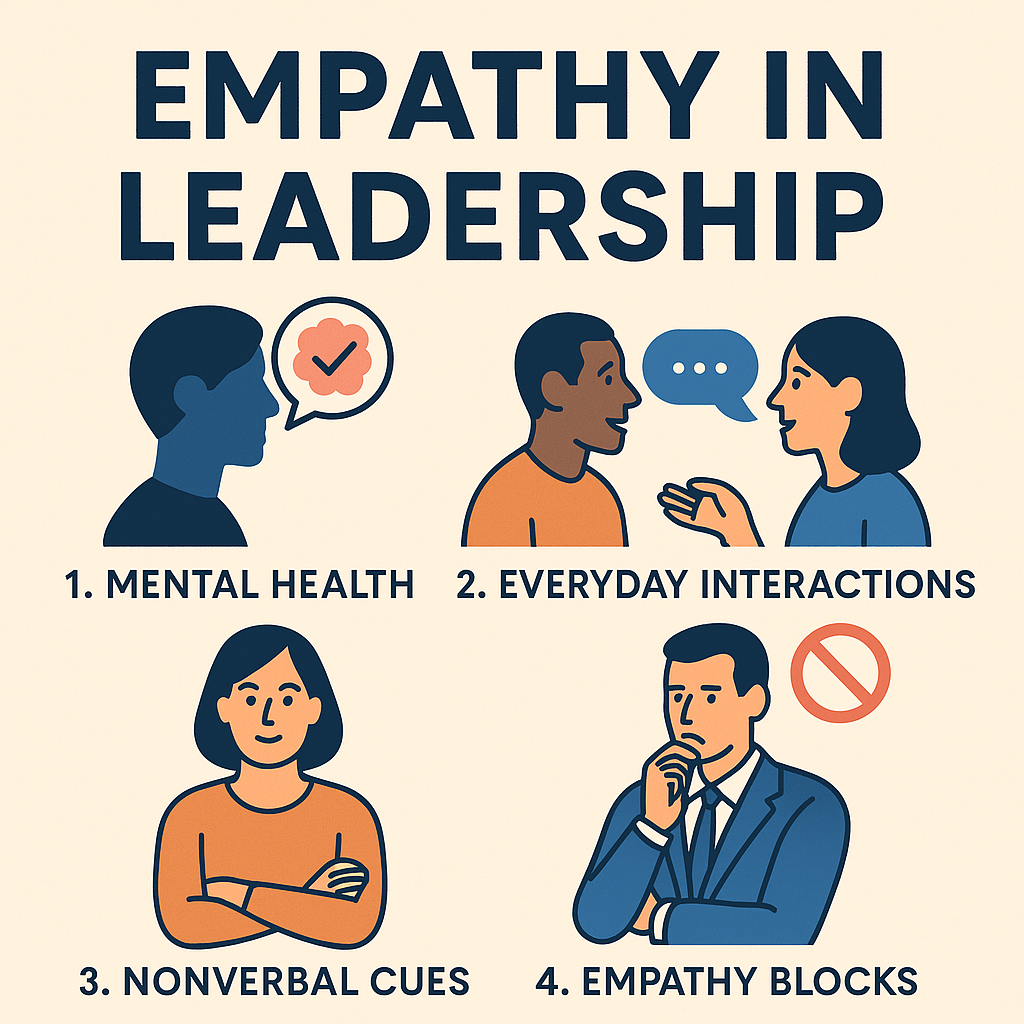
1. Prioritize Your Own Mental Health
Empathy requires emotional regulation. As a leader, if you’re burned out, anxious, stressed, or overwhelmed, it becomes harder to support your team. Unmanaged personal distress can also make it difficult to empathize with others.
Here’s what that looks like:
- Regulate before you respond—pause when emotions run high.
- Normalize mental health conversations in the workplace.
- Lead by example with boundaries, rest, and support.
A mentally healthy leader is a more empathetic, present, and sustainable one.
2. Practice Empathy in Everyday Interactions
Empathy isn’t reserved for 1:1s or crises. It lives in small, daily moments.
Try these micro-practices at work:
- Call team members by name and acknowledge their efforts.
- Listen without multitasking.
- Check in on people outside of performance reviews—just because.
Micro-empathy builds macro-trust over time.
3. Be Clear and Respectful in Casual Workplace Relationships
Not every work interaction is deep, but every interaction still deserves dignity. This is especially true for casual relationships in the workplace, which are non-committal, flexible connections that can vary in frequency, intimacy, and emotional involvement.
Casual relationships in the workplace can take many forms, from brief collaborations to ongoing partnerships. The form these relationships take often depends on the structure of the project, the level of contact, and the stage of development.
In team collaborations, cross-functional projects, or even brief email threads:
- Be clear about your expectations and respectful of others’ boundaries.
- Give feedback that’s both honest and kind.
- Avoid ghosting or abrupt communication shutdowns.
Casual interactions shape culture. Lead them with empathy.
4. Strengthen Relationships with Empathetic Habits

Strong professional relationships require more than shared goals—they require shared humanity. Building strong relationships depends on developing key skills such as empathy, communication, and conflict resolution.
As a leader, you can strengthen connections through:
- Weekly emotional check-ins during team huddles or 1:1s.
- Empathy journaling—briefly reflecting on someone else’s POV.
- “Mirroring”—restating what someone said to validate you heard them.
Developing these skills is essential for fostering empathy and relationship building. Good relationships are built on empathy, communication, and trust.
Consistency is key. Empathy compounds when practiced regularly.
5. Learn to Read and Respond to Nonverbal Cues
Communication is over 70% nonverbal. Great leaders don’t just listen with their ears—they watch with their eyes. Nonverbal communication is a form of behavior that conveys important information about a person’s feelings, intentions, and engagement.
Pay attention to:
- Tone shifts or sudden silence in meetings.
- Body language like crossed arms, restlessness, or downward gazes.
- Physical behavior such as posture and gestures.
- Employees who say “I’m fine” but appear anything but.
Being fluent in nonverbal cues helps you lead with presence and prevent miscommunication before it escalates.
6. Recognize and Remove Empathy Blocks
Even the most well-meaning leaders hit empathy walls. These might include:
- Emotional fatigue (especially for leaders supporting large teams).
- Implicit bias or unconscious judgment.
- Workplace stress or personal trauma.
It’s important to recognize that empathic concern—an other-oriented compassion—motivates effective helping behavior, while personal distress can lead to emotional withdrawal or burnout.
To overcome them:
- Practice mindfulness and reflection.
- Engage in bias awareness training.
- Ask your team, “What do you need from me?” and really listen.
Empathy isn’t always easy—but it’s always worth the effort.
7. Use Empathy-Based Communication Strategies
Empathy changes how you communicate, not just what you say. Talking openly and honestly is essential to foster empathy, as it encourages everyone to share their feelings, needs, and concerns. The best framework for empathetic dialogue is Nonviolent Communication (NVC):
Here’s how to use it in tough conversations, while considering various perspectives:
- Observation: “When I saw the missed deadline…”
- Feeling: “…I felt concerned…”
- Need: “…because I value reliability on this team.”
- Request: “Can we put a system in place to track progress together?”
This style reduces defensiveness and opens the door to real solutions through open talk and effective talking.
8. Lead by Modeling Empathy Across the Organization
Empathy is contagious—but only when modeled consistently by leadership.
Show it in your leadership through:
- Authenticity: Admit when you’re wrong or uncertain.
- Inclusivity: Create space for every voice at the table.
- Courage: Make empathy a policy, not just a personal value.
When leaders model empathy, they motivate people to act with kindness and cooperation, inspiring prosocial behaviors that can positively impact the organization and society as a whole.
Your team will watch how you treat others in moments of stress, failure, and success. That’s when your empathy leaves its biggest mark.
Building a Culture of Empathy

Leaders don’t just influence people—they shape culture. If you want a high-performing, resilient team, empathy has to be part of the foundation. A shared team identity can foster empathy and collaboration, helping members feel a sense of belonging and unity.
Here’s how empathetic leadership shows up:
- You pause to make sure everyone’s voice is heard in a meeting.
- You validate emotions before solving a problem.
- You ask “What do you need from me right now?” instead of assuming.
Practical tools leaders can implement:
- Weekly 1:1s with real emotional check-ins
- Leadership journaling—reflecting on how you responded emotionally that week
- Team empathy circles—short forums for team members to share concerns, feedback, or praise
- Aligning around a common goal—ensuring everyone understands and works toward shared objectives to build trust
Empathy builds trust. Trust builds performance and leads to positive relationships within the team.
Recognizing Nonverbal Cues in the Workplace
Most of what your team communicates won’t be in words. Body language, tone of voice, and facial expressions often say more than status updates ever could.
Key nonverbal cues for leaders to watch for:
- Sudden withdrawal in a previously engaged employee
- Eye contact that communicates confidence—or lack of it
- Micro-expressions during tough conversations
If you’re not noticing these cues, you’re missing essential emotional data.
As a leader, the ability to read the room—especially when something feels “off”—helps you intervene early, provide support, and build rapport.
Overcoming Empathy Blocks as a Leader

Even the best leaders face empathy roadblocks. Maybe you’re under pressure, emotionally exhausted, or unsure how to respond to a situation.
Common empathy blockers in leadership:
- Burnout or decision fatigue
- Judgment or unconscious bias
- Emotional detachment due to constant stress
- Assuming intent instead of asking questions
- Influence of past experiences—previous relationships or upbringing can shape current responses and create empathy blocks, often without conscious awareness
How to overcome these blocks:
- Build self-awareness (via reflection or executive coaching)
- Practice active listening—repeating back what you heard before offering a solution
- Solicit real-time feedback on how your leadership style is being perceived
Empathy takes effort, but it pays off in deeper trust, fewer misunderstandings, and better business outcomes.
Conclusion: Lead with Empathy, Lead with Strength
Empathy isn’t about being agreeable or avoiding hard truths—it’s about showing people that they’re seen, heard, and valued. As a leader, it’s your responsibility to create an environment where people can bring their full selves to work.
Empathy builds trust. Trust builds performance. And performance builds outcomes.
But more than that, empathy humanizes the workplace—and that’s what the future of leadership demands.
Make empathy your leadership advantage. Not just because it feels good—but because it works.

10 Essential Leadership Qualities That Drive Revenue
Effective leadership is the engine behind sustainable growth and profitability in any business. It transforms challenges into opportunities and ideas into income. Discover the ten essential leadership qualities that not...
Read More
8 Guaranteed Steps to Develop Empathy for Meaningful Leadership
Empathy isn’t a soft skill—it’s a leadership advantage. In workplaces where pressure runs high, leaders who can genuinely understand and respond to others’ emotions build stronger, more loyal, and more...
Read More
The Silent Crisis in Tech: Why EQ Is The Key For Successful IT Teams
In the fast-paced world of technology, one crucial element often gets overlooked: emotional intelligence (EQ). While cutting-edge innovations drive progress, it’s the people behind the tech who truly make a...
Read More
Mastering the 5 Levels of Leadership: Your Path to Effective Influence
Have you ever looked at an inspiring leader and wondered, "How do they lead so effectively?" Leadership isn't just a natural gift; it can be developed with effort and the...
Read More